

Key Takeaways
- Weight loss on GLP-1 medications almost always slows and plateaus over time.
- A plateau is usually metabolic adaptation, not the medication failing.
- In the STEP trials, weight loss commonly leveled off around week 60.
- Protein, strength training, and a physician review are the best next steps.

If your weight loss on a GLP-1 medication has slowed or stopped, you are not doing anything wrong, and the medication is very likely still working. Plateaus are a normal, expected part of every weight loss journey. Here in Las Cruces, Dr. Joanna Rachelson and Dr. Laura Leija-Urrea walk patients through this stage all the time. Understanding why a stall happens, and what actually helps, turns a frustrating moment into a manageable one.
Is it normal for weight loss to stall on GLP-1 medications?
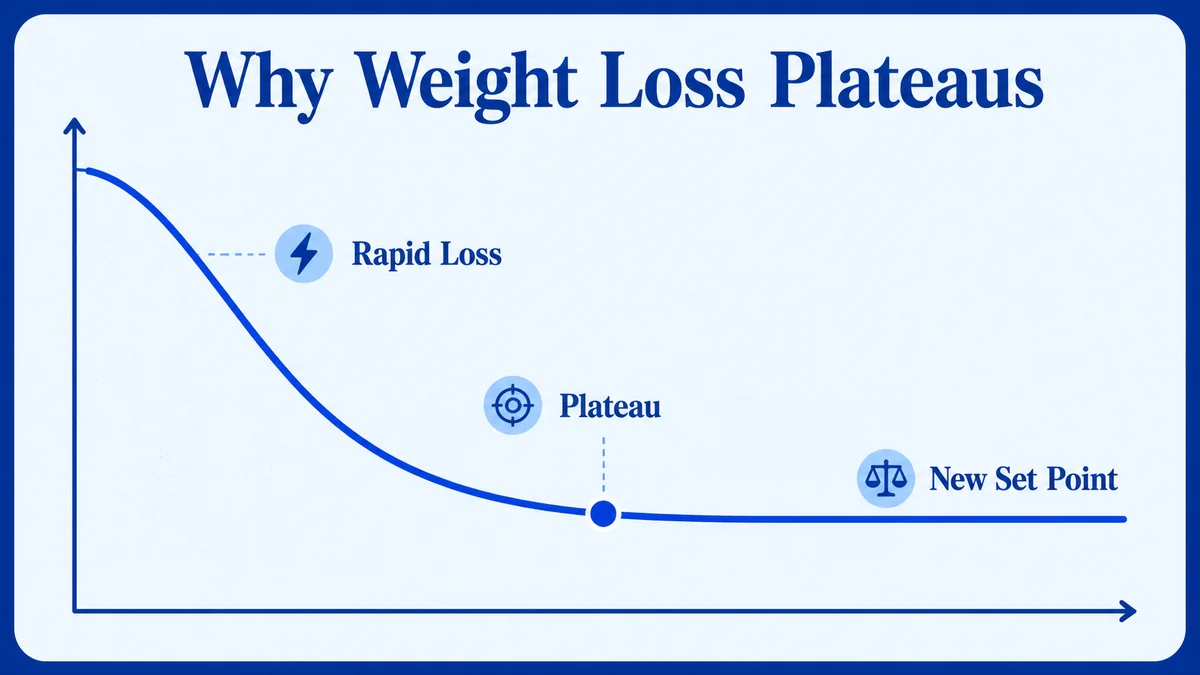
Yes, it is completely normal. Every weight loss method, medication included, slows over time and eventually levels off. In the landmark STEP 1 trial of semaglutide, participants lost about 14.9 percent of their body weight by week 68, but that loss did not continue forever. It followed a curve: fast at first, then gradually flattening.
A plateau does not mean failure. More often it means your body has found a new, more stable weight, or set point, and is holding there. That is actually a sign of success, especially if you are keeping muscle and feeling stronger. The key is to understand the mechanism so you can respond calmly rather than giving up.
It also helps to reset expectations about the shape of weight loss. Very few people lose weight in a straight line. The usual pattern is a brisk early drop, a slower middle stretch with several small stalls, and then a longer flattening as you approach your body's comfortable range. Knowing that the curve bends is often enough to keep a normal slowdown from feeling like a setback.
What is metabolic adaptation?
Metabolic adaptation is your body's tendency to burn fewer calories after weight loss. As you get lighter, you need less energy to run your body, and research shows resting energy expenditure can fall by even more than your smaller size alone would predict. That narrowing of your calorie deficit is the main engine behind most plateaus.
Studies of energy expenditure with weight loss describe this adaptive drop in metabolism, sometimes called adaptive thermogenesis. It is an ancient survival response: your body cannot tell the difference between an intentional weight loss plan and a food shortage, so it becomes more efficient. A few things feed into it.
- A smaller body burns fewer calories at rest and in motion.
- Lost muscle lowers your metabolism further, which is why protecting muscle matters.
- Hormonal shifts can nudge appetite and energy use as you lose weight.
This is one reason keeping lean tissue is so important. Our guide on protecting muscle on semaglutide explains how protein and strength training help keep your metabolism from slowing more than it needs to.
The practical takeaway is that a plateau is not a signal to slash your food further. Eating too little can backfire, pulling more from muscle and deepening the metabolic slowdown you are trying to avoid. A steadier approach that protects lean mass usually serves you better than an aggressive crackdown, which is exactly the kind of judgment a supervised program is built to provide.
When do plateaus usually happen?
For many people on semaglutide, weight loss slows noticeably and then plateaus somewhere in the range of a year of treatment. In the two-year STEP 5 trial, weight loss with semaglutide leveled off around week 60 and was then largely maintained through the rest of the study.
Smaller stalls can happen much earlier, too, often lasting a week or two before the scale moves again. Daily weight naturally bounces around because of water, sodium, hormones, and digestion. A true plateau is a flat trend over several weeks, not a single stubborn morning on the scale.
The timing also tracks with dosing. Early in treatment, as your dose steps up, appetite tends to fall further and the scale keeps moving. Once you reach and hold a stable dose, that extra push levels off, and your progress naturally settles into whatever your habits and metabolism support. That is a normal handoff, not a sign the medication has quit working.
How long should you wait before worrying about a plateau?
Give it a few weeks before reading too much into it. Because daily weight swings with water, salt, hormones, and digestion, a flat scale for a week or two is normal and rarely meaningful. A stall worth discussing with your provider is usually one that lasts several weeks with no change in measurements, strength, or how your clothes fit.
One of the most useful shifts you can make is to stop treating the scale as the only scoreboard. Body composition can keep improving even when weight holds steady, especially if you are adding strength work while losing fat. That is why we encourage patients to track a wider set of signals.
- How your clothes fit and how you feel in them.
- Waist measurement, which can shrink even when the scale does not.
- Strength, stamina, and energy through the day.
- Blood pressure, blood sugar, and other health markers your provider tracks.
Weighing at the same time of day, a few times a week rather than daily, also smooths out the noise and makes a real trend easier to see. If several weeks pass with no movement across any of these measures, that is the moment to bring it to your provider.
What can you do about a weight loss stall?
The best first step is a calm review with your provider rather than a drastic change on your own. Together you can look at protein, activity, sleep, and consistency, then decide whether to adjust your plan or simply recognize that you have reached a healthy maintenance weight. Small, sustainable tweaks tend to work better than crash efforts.
- Prioritize protein and fiber to stay full and protect muscle.
- Add or increase resistance training two to three times a week.
- Check sleep, stress, and hydration, which all affect appetite and energy.
- Track strength, measurements, and how clothes fit, not just the scale.
A plateau may be your goal weight
Sometimes a stall simply means your body has settled at a healthy weight. Maintaining that loss is a real win. If you are near the end of a program, see our guide on maintaining weight loss after semaglutide.
Do you need a higher dose to break a plateau?
Not necessarily, and this is a decision only your physician should make. A plateau does not automatically mean you need more medication. Your provider weighs your progress, your side effects, and your overall health before adjusting anything, because more is not always better and semaglutide is not appropriate for everyone.
This is exactly where a supervised program earns its value. We can review your dose, confirm whether you are titrated appropriately, and rule out other explanations before making a change. If you are still early in treatment, our post on how long semaglutide takes to work sets realistic expectations. You can also compare options in our semaglutide vs tirzepatide guide.
Frequently asked questions
Why did my weight loss stop on semaglutide?
A plateau usually means your body has adapted. As you lose weight, your metabolism slows and you need fewer calories, so the same routine no longer creates a deficit. In the STEP trials, weight loss commonly leveled off around week 60 and then held steady, which is a normal part of the process.
Is a weight loss plateau on GLP-1 medication bad?
Not usually. A plateau often means your body has reached a new, more stable set point, not that the medication has stopped working. Holding a lower weight is itself a meaningful result, especially when you are keeping muscle and building healthy habits.
What is metabolic adaptation?
Metabolic adaptation is your body's tendency to burn fewer calories at rest after weight loss, sometimes more than the drop in body size alone would predict. It is a survival response that narrows your calorie deficit and helps explain why weight loss slows over time.
How do you break a semaglutide plateau?
Start by reviewing protein, activity, sleep, and consistency with your provider. Adding resistance training, tightening nutrition, or adjusting your dose under medical guidance can help. Your physician may also confirm whether you have simply reached a healthy maintenance weight.
Should I increase my dose if I hit a plateau?
Only under physician guidance. A plateau does not automatically mean you need more medication. Your provider weighs your progress, side effects, and health before changing a dose, since more is not always better and semaglutide is not appropriate for everyone.

Joanna Rachelson, MD
Dr. Joanna Rachelson is a licensed Family Medicine physician at Fountain of Youth LC in Las Cruces, NM, where she and Dr. Laura Leija-Urrea, MD, lead physician-supervised medical weight loss, hormone therapy, and IV wellness care. Meet the team.
Stuck at a plateau in Las Cruces?
Book a consultation and our physicians will review your plan, protect your progress, and map out the right next step.
Disclaimer: This content is for informational purposes only and is not medical advice. Results vary by individual and are not guaranteed. Semaglutide is a prescription GLP-1 medication that requires a physician evaluation, is not appropriate for everyone, and can cause side effects. Before starting, changing, or stopping any medication, consult a licensed healthcare provider.