
Key Takeaways
- Bioidentical means the hormone has the same structure as the one your body makes. It says nothing about safety on its own.
- Many bioidentical hormones come as FDA-approved products. Compounded versions are not FDA-approved.
- Pellets, gels, patches, pills, and shots all deliver hormones differently, and each has trade-offs.
- Every plan should start with symptoms, labs, and a physician evaluation, then follow-up labs to adjust the dose.
"Bioidentical" is one of the most common words people bring to a hormone visit, and one of the most misunderstood. Some hear it and think natural, safe, or custom. Others have been told it is marketing. The truth sits in between, and knowing it helps you ask better questions about bioidentical hormone therapy, often shortened to BHRT.
This guide explains what the word really means, the difference between FDA-approved and compounded hormones, how the main forms compare, and what to expect when you start hormone therapy with a physician in Las Cruces.
What does bioidentical mean?
A bioidentical hormone has the same chemical structure as a hormone the human body makes, such as estradiol, progesterone, or testosterone. Most are made in a lab, often starting from plant compounds. "Bioidentical" describes the molecule. It does not tell you how the product was made, whether it was tested, or whether it is right for you.
That last point matters, because many people assume bioidentical hormones are only available from special pharmacies. In fact, several common prescriptions are bioidentical and FDA-approved, including estradiol patches, gels, and pills, and micronized progesterone capsules. For men, FDA-approved testosterone products include injections such as testosterone cypionate.
What is the difference between FDA-approved and compounded BHRT?
FDA-approved hormones are made to a tested, consistent dose and come with a label that lists their risks. Compounded hormones are mixed by a pharmacy for one patient and are not FDA-approved, so no one has checked them for safety, effectiveness, or dose accuracy in the same way.
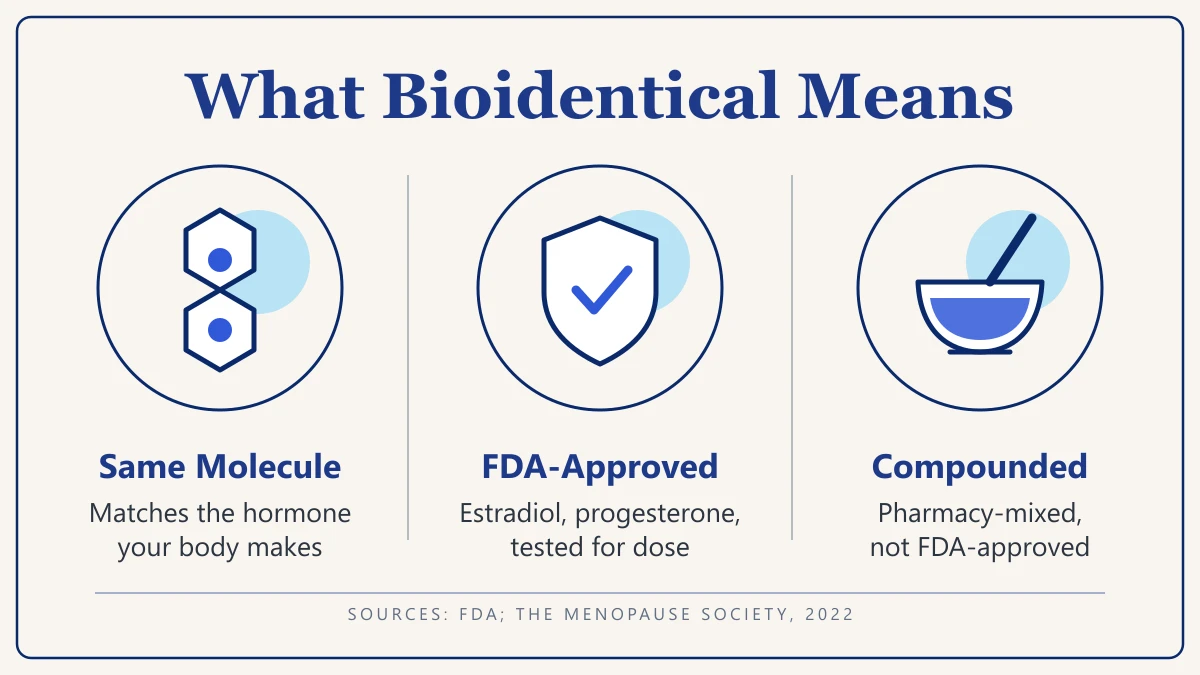
Compounding has a real place. It can help someone who is allergic to an ingredient in an approved product, or who needs a dose or form that is not made. But a 2020 report from the National Academies of Sciences, Engineering, and Medicine found too little evidence to support the routine use of compounded hormones, and advised prescribers to limit them to specific medical needs. The Menopause Society lists safety concerns that include overdosing or underdosing, impurities, and the lack of a label that explains the risks.
Are bioidentical hormones safer?
There is no good evidence that bioidentical or compounded hormones are safer than other hormone therapy. A hormone that matches your own still acts like your own, which means it carries the same risks at the same doses.
The FDA's guide to menopause medicines notes that for some women, hormone therapy can raise the chances of blood clots, heart attacks, strokes, breast cancer, and gallbladder disease. Women who still have a uterus and take estrogen generally also need a progestogen, such as progesterone, to protect the lining of the uterus. None of this means hormone therapy is a bad choice. For many people, especially for hot flashes, night sweats, and poor sleep, the benefits can outweigh the risks. It means the choice should be made with a physician, not a sales page.
The label on the hormone matters less than the plan around it: the right person, the right dose, and labs that tell us how it is going.
Pellets, gels, patches, pills, or shots: how do they compare?
The same hormone can be given in several ways, and the form changes how steady your levels are, how easy it is to adjust the dose, and how often you need to think about it.
| Form | How it works | Trade-off |
|---|---|---|
| Pellets | Tiny implants placed under the skin of the hip, releasing hormone over a few months | Nothing to remember, but the dose cannot be lowered until the pellet wears off |
| Injections | Testosterone cypionate given every week or every few weeks | Easy to adjust, but levels rise and fall between shots |
| Patches and gels | Absorbed through the skin every day or few days | Steady levels, but gels can rub off on partners or children |
| Pills and capsules | Taken by mouth, such as progesterone capsules at bedtime | Simple, but oral estrogen may carry a higher clot risk than skin forms |
Pellets get the most questions. FDA-approved testosterone pellets exist for men, while estradiol pellets in the U.S. are compounded. Small side effects at the insertion site, such as bruising, soreness, or a pellet working its way out, can happen. Because the dose is locked in for months, checking labs before the first pellet and before the next one matters even more.
Who is BHRT for, and who should avoid it?
Hormone therapy is most often used for menopause symptoms in women, such as hot flashes, night sweats, sleep trouble, and vaginal dryness, and for men with symptoms and repeated lab results that confirm low testosterone. Our guides to hormone therapy for women over 40 and low testosterone symptoms in men go deeper on the signs.
Hormone therapy may not be right for you if you have had
- Breast cancer, or for men, prostate or breast cancer
- Blood clots, a stroke, or a heart attack
- Liver disease
- Vaginal bleeding that has not been explained
Testosterone for women deserves its own note. In the U.S. there is no FDA-approved testosterone product for women, so when it is prescribed, mostly for low sex drive after menopause, it is used off-label and needs careful dosing and monitoring. Ask your physician to walk you through the reasons and the risks.
How does BHRT start in Las Cruces?
At Fountain of Youth LC, hormone therapy starts with a lab panel and a health history review with one of our two licensed physicians. From there we talk through your options, which can include pellets, testosterone cypionate injections, and progesterone, and we use follow-up labs to adjust the dose. If hormone therapy is not a good fit, we will say so.
Read more about hormone replacement therapy in Las Cruces, including care for women and men, or see current prices on our pricing page. The whole visit can be in English or Spanish.
Frequently asked questions
What does bioidentical hormone therapy mean?
Bioidentical hormones have the same chemical structure as the hormones your body makes, such as estradiol, progesterone, and testosterone. The word describes the molecule. It does not tell you whether a product is FDA-approved or compounded, and it does not mean the product is safer.
Are bioidentical hormones safer than other hormone therapy?
There is no good evidence that they are. A hormone that matches your own still carries the same risks, such as blood clots, stroke, and, with some treatments, breast cancer. The Menopause Society and the FDA both warn against claims that bioidentical products are risk-free.
Is compounded BHRT FDA-approved?
No. Compounded hormones are mixed by a pharmacy for one patient and are not FDA-approved, so the FDA has not checked them for safety, effectiveness, or dose accuracy. Several bioidentical hormones are available as FDA-approved products, including estradiol and micronized progesterone.
How long do hormone pellets last?
Pellets release hormone slowly over a few months, and the exact time varies from person to person. Because a pellet cannot easily be taken out, the dose cannot be lowered until it wears off, which is one reason labs before and after matter.
Who should not take hormone therapy?
Hormone therapy is not a good fit for some people, for example some people with a history of breast or prostate cancer, blood clots, stroke, liver disease, or unexplained vaginal bleeding. A physician evaluation decides whether it is right for you.

Joanna Rachelson, MD
Physician at Fountain of Youth LC in Las Cruces, New Mexico, where the team provides physician-supervised hormone therapy, medical weight loss, and wellness care. Read more about Dr. Rachelson.
Talk it through with a physician.
We start with your symptoms and labs, explain every option plainly, and only recommend hormones if they fit you.
Disclaimer: This content is for informational purposes only and is not medical advice. Results vary by individual and are not guaranteed. Hormone therapy is prescription treatment that requires a physician evaluation, is not appropriate for everyone, and carries risks. Compounded hormones are not FDA-approved. Before starting, changing, or stopping any treatment, consult a licensed healthcare provider.