

Key Takeaways
- The most specific signs of low testosterone are sexual: lower drive, fewer morning erections, and erection problems. Fatigue and weight gain are common but far less specific.
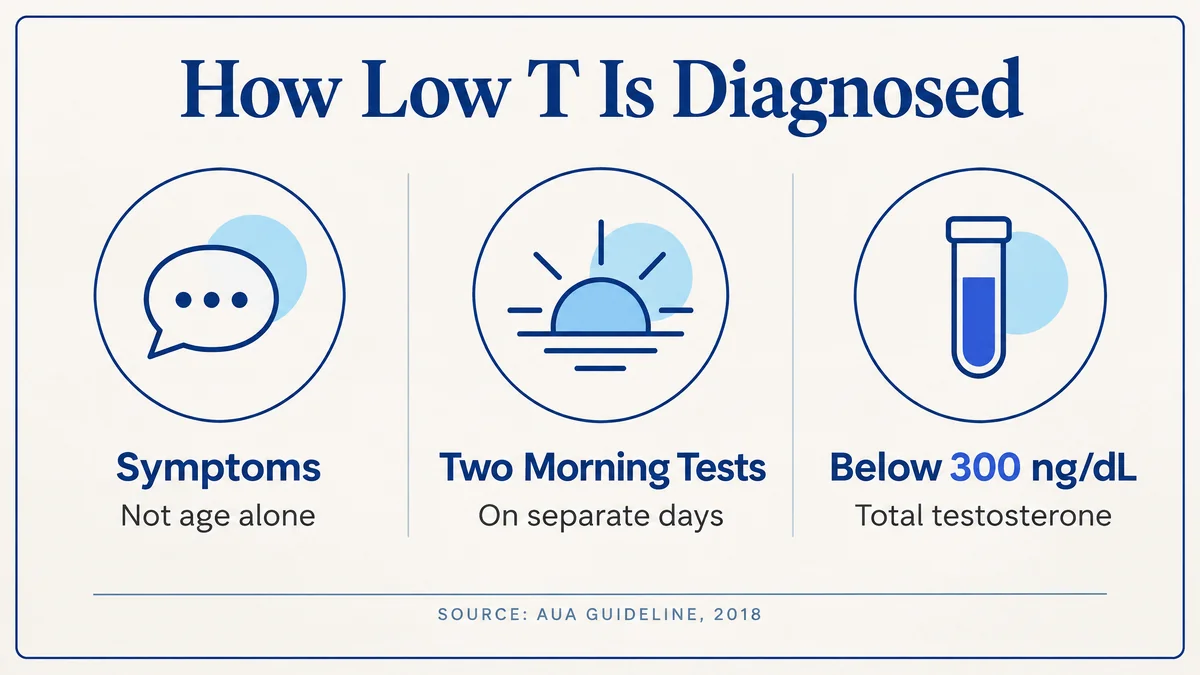
- Low T is a lab diagnosis: symptoms plus two early morning blood tests showing total testosterone below 300 ng/dL.
- Sleep apnea, excess weight, type 2 diabetes, depression, and some medications can look exactly like low T, and sometimes cause it.
- Before any testosterone therapy, ask about fertility, hematocrit, and PSA. A good clinic raises all three before you do.

Most men who come to Fountain of Youth LC in Las Cruces asking about testosterone have already done some reading. They are tired by mid-afternoon, the gym is not paying off the way it used to, and something feels flat. The honest answer about low testosterone symptoms in men is that a few signs point strongly toward it, many more are shared with other common problems, and the only way to know is a proper evaluation with the right blood tests drawn at the right time of day. This guide walks through all three so you know what to look for and what to ask.
What are the signs of low testosterone in men?
The signs that point most specifically to low testosterone are sexual: a lower sex drive, fewer morning or spontaneous erections, and trouble getting or keeping an erection. The Cleveland Clinic lists these as the most specific symptoms, alongside less common but telling ones such as loss of body hair, hot flashes, and shrinking testicles.
The second group is what most men actually notice first, and it is much less specific:
- Fatigue and low energy that sleep does not seem to fix
- Low or flat mood, irritability, and a shorter fuse
- Poorer concentration and memory
- Losing muscle and strength despite training
- More body fat, especially around the middle
- Poorer sleep
Every item on that list can also come from poor sleep, stress, weight gain, or a dozen other causes. That is not a reason to ignore them. It is the reason a checklist on the internet cannot diagnose you, and the reason we never treat on symptoms alone.
What testosterone level is considered low?
The American Urological Association uses a total testosterone level below 300 ng/dL as a reasonable cut-off, and only after two separate early morning blood tests. The AUA testosterone deficiency guideline (published 2018, validity confirmed 2024) is clear that the diagnosis requires both: a low level on repeat testing and symptoms or signs that fit.
300 ng/dL
The total testosterone cut-off the AUA guideline uses in support of a diagnosis.
American Urological Association, 2018
About 1% a year
How much testosterone levels can drop each year starting in a man's late 30s.
Cleveland Clinic
Why the morning? Testosterone is highest early in the day, so an afternoon draw can read low in a man whose levels are perfectly normal. A single low result can also come from a bad night, a recent illness, or lab variation, which is why the guideline asks for a second test on a different day before anyone calls it deficiency.
Is it low T, or something that looks like it?
Several common conditions produce the same fatigue, low mood, and weight gain, and some of them lower testosterone too. The Cleveland Clinic lists obesity, poorly managed type 2 diabetes, obstructive sleep apnea, being older than 45, and chronic kidney or liver disease as risk factors. The AUA's patient site adds chronic opioid use and pituitary problems to the conditions that should prompt testing.
Worth ruling out alongside your testosterone
- Obstructive sleep apnea, especially with loud snoring or daytime sleepiness
- Type 2 diabetes or prediabetes
- Thyroid problems and anemia
- Depression, which shares many of the same symptoms
- Medications, including opioids and some others that affect hormones
This is not a reason for a man with real symptoms to be brushed off. It is the reason a good evaluation looks at the whole picture, so that treatment fixes the actual problem rather than covering one symptom of it.
We would rather tell a man his testosterone is fine and find the real reason he is exhausted than put him on a treatment he does not need.
How the physicians at Fountain of Youth LC approach men's hormone visits
How is low testosterone tested?
Testing starts with a conversation about symptoms and history, then a morning blood panel, then a repeat test to confirm. At our Las Cruces clinic the process looks like this:
- 1History and symptoms. Sleep, energy, sex drive, medications, weight changes, and whether children are still in your plans. Fertility changes what we would even consider.
- 2A full morning panel. Total and free testosterone, LH, FSH, estradiol, SHBG, PSA, lipids, and a CBC. LH and FSH help show whether the issue starts in the testes or in the signals from the brain.
- 3Confirmation. A second early morning test before calling it testosterone deficiency, as the AUA guideline recommends.
- 4A plain-English results visit. Two licensed Family Medicine MDs review your numbers and explain them, including when the answer is that testosterone is not the problem.
The AUA guideline also notes that some studies estimate up to 25% of men who receive testosterone therapy were never tested before starting it. That is the pattern we want to avoid. You can see what the full program includes on our TRT and men's hormone therapy page.
Does losing weight raise testosterone?
For some men it can help, because excess weight and low testosterone tend to travel together. The Cleveland Clinic notes that late-onset low testosterone is more common in men with type 2 diabetes, overweight, and obesity, and the AUA guideline recommends counseling every man with testosterone deficiency on lifestyle changes as part of treatment.
In practice that means sleep, strength training, and steady weight loss are part of the conversation before or alongside any prescription. For men carrying significant extra weight, a physician-supervised medical weight loss program can be part of that plan. GLP-1 medications are prescription drugs with real side effects and are not right for everyone, so that decision is made with your physician after a full evaluation. If you go that route, our guide to protecting muscle on semaglutide matters even more for men watching their strength.
What to know before starting TRT
Testosterone therapy can help men with confirmed deficiency, but it has trade-offs you should hear about before the first dose. The AUA guideline sets out several that a careful clinic will raise with you:
| Topic | What the AUA guideline says |
|---|---|
| Fertility | Testosterone should not be prescribed to men currently trying to conceive, and men interested in fertility should have a reproductive evaluation first. |
| Blood count | Hemoglobin and hematocrit should be measured first, because therapy raises the risk of a high red blood cell count. |
| Prostate | PSA should be measured in men over 40 before starting. |
| Monitoring | Testosterone levels should be checked every 6 to 12 months while on therapy. |
At Fountain of Youth LC we track hematocrit, PSA, estradiol, and lipids at follow-up visits, and if you still want children we talk through fertility-preserving options before anything starts. Results vary from man to man, and the right choice between injections, pellets, or no testosterone at all depends on your labs and your life rather than a one-size protocol.
Frequently asked questions
What are the first signs of low testosterone in men?
The most specific early signs are sexual: lower sex drive, fewer morning erections, and difficulty with erections. Fatigue, low mood, poor concentration, losing muscle, and gaining fat around the middle are common too, but those overlap with sleep problems, stress, and other conditions. That overlap is why symptoms start the conversation and blood tests settle it.
What testosterone level is considered low?
The American Urological Association uses a total testosterone level below 300 ng/dL as a reasonable cut-off, confirmed on two separate early morning blood tests. A low number on its own is not a diagnosis. Testosterone deficiency means a low level together with symptoms or signs that fit.
Can losing weight raise testosterone?
Low testosterone is more common in men with obesity and type 2 diabetes, and the AUA guideline recommends counseling every man with testosterone deficiency on lifestyle changes. For some men, losing weight, treating sleep apnea, and improving sleep can help their levels and symptoms. Your physician can tell you whether that is a realistic first step for you.
Will testosterone therapy affect fertility?
It can. Testosterone therapy suppresses the signals that drive sperm production, and the AUA advises against it for men who are currently trying to conceive. If children are still in your plans, say so at your first visit so your physician can discuss fertility-preserving options before anything starts.
How much does a low testosterone evaluation cost in Las Cruces?
At Fountain of Youth LC a new patient consult with labs is $200, and the full hormone panel covers total and free testosterone, LH, FSH, estradiol, SHBG, PSA, lipids, and a CBC. Treatment, if it is appropriate, is priced separately and explained before you commit to anything.

Joanna Rachelson, MD
Family Medicine physician at Fountain of Youth LC in Las Cruces, New Mexico, where the team provides physician-supervised hormone therapy for men and women, medical weight loss, and IV therapy. Medically reviewed by Laura Leija-Urrea, MD. Read more about Dr. Rachelson.
Find out what your numbers actually say.
A morning panel, two physicians who read it with you, and a straight answer, in English or Spanish, here in Las Cruces.
Disclaimer: This content is for informational purposes only and is not medical advice. Results vary by individual and are not guaranteed. Testosterone therapy is a prescription treatment that requires a physician evaluation and laboratory testing, is not appropriate for everyone, and can cause side effects. GLP-1 medications are prescription drugs that require a physician evaluation. Before starting, changing, or stopping any treatment, consult a licensed healthcare provider.