

Key Takeaways
- Pellets and injections deliver the same hormone on a different rhythm: pellets every few months, injections every week or few weeks.
- Injections are easier to adjust and cost less per month. Pellets are hands-off but the dose is locked in until they wear off.
- A high red blood cell count was more common with injections in one study, so hematocrit is checked with every form.
- Any testosterone can lower sperm production and raise blood pressure, so fertility plans and blood pressure come up before the first dose.
- The right choice depends on your labs, your schedule and your budget, decided with a physician in Las Cruces.
Testosterone pellets vs injections is one of the first questions men ask us in Las Cruces once their labs confirm low testosterone. The short answer: both deliver the same hormone, and the real difference is rhythm. Pellets are placed under the skin a few times a year. Injections are given every week or every few weeks.
That one difference shapes almost everything else, from how easy the dose is to change to what you pay each month. This guide compares the two side by side using the FDA drug labels and published research, explains what a pellet visit actually involves, and lists our own prices so you can plan. It is not a substitute for a visit, because the right form for you depends on your labs and your health history.
What is the difference between testosterone pellets and injections?
Testosterone pellets are small solid implants placed in the fat under the skin during a short office visit, and they release testosterone slowly for several months. Testosterone injections, most often testosterone cypionate, are a liquid shot given every week to every few weeks. Pellets trade flexibility for convenience; injections trade convenience for control.
Both are FDA-approved ways to treat testosterone deficiency in men. The pellet most clinics refer to is Testopel, and its FDA label on DailyMed lists a dose of 150 mg to 450 mg every 3 to 6 months. The label for Depo-Testosterone, a brand of testosterone cypionate, lists 50 mg to 400 mg every 2 to 4 weeks. Compounded versions of both exist, and they are not FDA-approved, so it is fair to ask any clinic which product you would be getting.
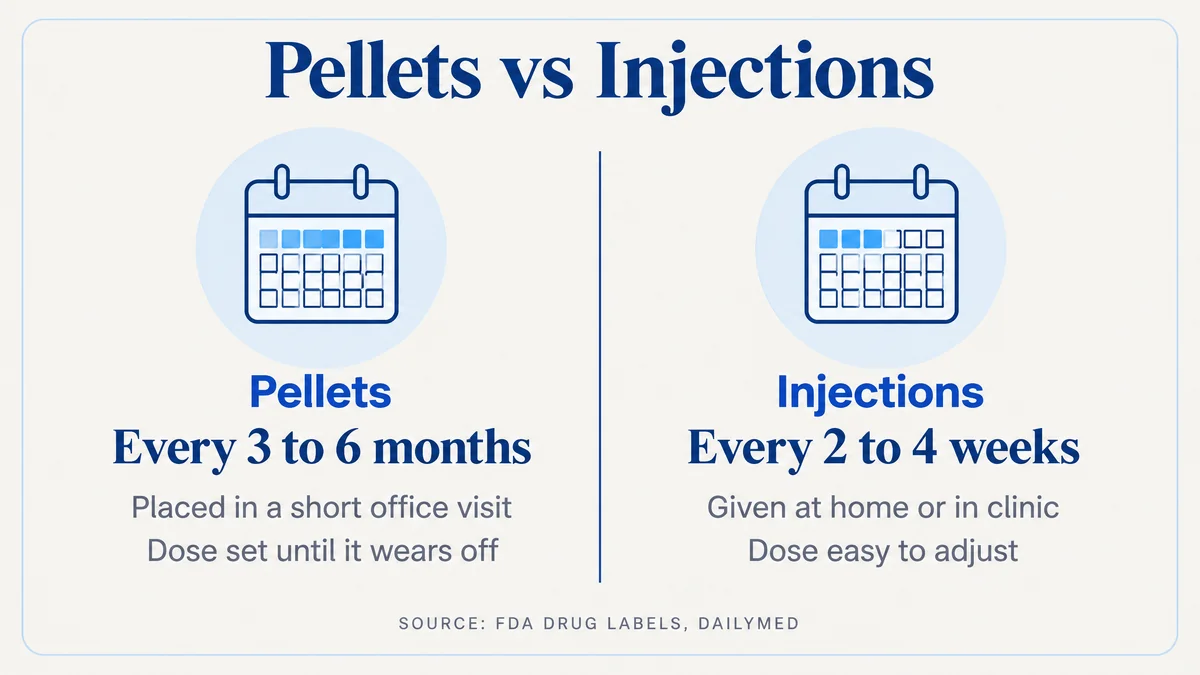
| Pellets | Injections | |
|---|---|---|
| How often | Every 3 to 6 months | Every 1 to 4 weeks |
| Who gives it | Your physician, in the office | You at home, or our staff in clinic |
| Changing the dose | Waits until the pellets wear off | Can change with the next shot |
| Level pattern | Slow rise, slow fade over months | Peak after the shot, dip before the next |
| Main hassle | A small procedure a few times a year | Remembering a regular shot |
How long do testosterone pellets last?
According to the FDA label for Testopel, the effect of a pellet dose ordinarily lasts 3 to 4 months and sometimes as long as 6 months. For most of our patients that works out to a new insertion about every 4 to 5 months, but your own timing is set by your labs and how you feel, not by a fixed calendar.
Pellets dissolve slowly, so levels rise over the first weeks and then taper off. The same label explains that the number of pellets is based on how much testosterone a man needs, and gives a starting example of 300 mg, or 4 pellets, lasting about three months for a man who had needed 50 mg a week by injection. How long your own dose lasts is something we learn from your labs, which is why the first round is a learning round.
The trade-off is that the dose cannot be turned down once the pellets are in. If your levels run high, you wait them out. That is why we check labs before the first pellet and again before the next one.
How often do you need testosterone injections?
The FDA label for testosterone cypionate allows a dose every 2 to 4 weeks. Many physicians, including ours, often split the same total amount into smaller weekly or twice-weekly doses, which keeps levels steadier between shots. Your schedule is set by your prescription and adjusted with follow-up labs.
Spacing matters because an injection works in waves. Levels climb in the days after a shot and drift down before the next one. With a long gap, some men notice energy or mood dipping near the end of the cycle. Shorter intervals soften those waves, and you can give the shot yourself at home after we show you how, or come in and let our staff do it.
The big advantage is control. If a lab comes back high, or a side effect shows up, the next dose can be smaller. If your levels are low, it can go up. That flexibility is why many men start on injections, even if they later move to pellets once a stable dose is found.
We would rather spend a few months finding your dose with injections than lock in the wrong one with a pellet.
That is how we explain our approach at Fountain of Youth LC. It is not a rule, and some men start on pellets and do well. But a known, steady dose makes a pellet plan easier to get right.
Are testosterone pellets better than injections?
Neither form is better for every man. Pellets suit men who want a hands-off routine and have a stable dose. Injections suit men who want lower monthly costs, a dose that is easy to change, or who are just starting therapy. The best choice is the one that fits your labs, your health and your life.
Pellets
- Nothing to remember between visits
- No self-injection at home
- Slow, gradual change in levels
- Dose cannot be lowered once placed
- A small procedure a few times a year
- Higher cost per visit
Injections
- Dose can change with the next shot
- Lower cost per month
- No incision
- A shot every week or few weeks
- Peaks and dips between doses
- Higher red blood cell count more common
Research backs up a few of these differences. A 2015 study in Sexual Medicine followed 178 men who stayed on one form of testosterone: 47 on gels, 57 on injections and 74 on pellets. All three raised testosterone. Injections caused the largest changes in hemoglobin and hematocrit, and estradiol stayed raised longer with injections and gels than with pellets.
What are the side effects of testosterone pellets vs injections?
Both forms share the same core risks, including a higher red blood cell count, higher blood pressure, acne, and lower sperm production. Pellets add insertion-site issues such as soreness, bruising, infection, or a pellet working its way out. Injections are more often linked to a high hematocrit, and some men feel the peaks and dips between shots.
66.7%
of men on injections developed a hematocrit above 50%, compared with 35.1% on pellets and 12.8% on gels
Source: Pastuszak et al., Sexual Medicine, 2015
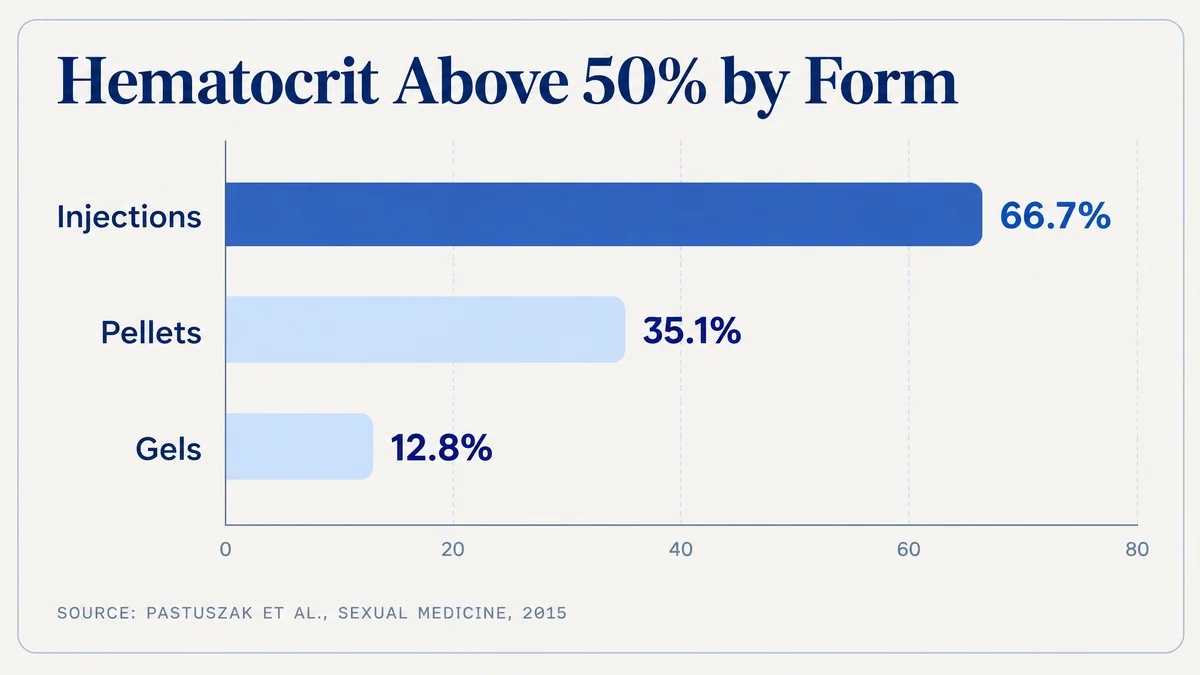
Hematocrit is the share of your blood made up of red cells. When it climbs too high, blood gets thicker, which is why the American Urological Association guideline calls for checking it before therapy starts and during treatment.
Blood pressure is the other shared watch point. In February 2025 the FDA required class-wide labeling changes for testosterone products after blood pressure studies confirmed that all testosterone products can raise blood pressure. The same update followed the TRAVERSE trial, in which major heart events occurred in 7.0% of men on testosterone and 7.3% on placebo, a result the trial authors judged noninferior. So we check your blood pressure at visits, and we treat it if it climbs.
For pellets specifically, the insertion site is where most problems show up. A 2014 review of testosterone pellets cited early clinical experience with extrusion, a pellet coming out through the skin, in 5 to 12% of cases and infection in 1.4 to 6.8%. Careful technique and good aftercare keep those numbers down, but they are worth knowing.
Call your physician if you notice
- Redness, heat, swelling or drainage at a pellet site, or a pellet coming out
- Headaches, flushing or a blood pressure reading higher than usual
- Swelling of the ankles, or new shortness of breath
- Pain or swelling in one leg, or chest pain. For chest pain or trouble breathing, call 911
What is a testosterone pellet insertion like?
A pellet insertion is a short in-office visit. The skin, usually on the upper hip, is numbed, a tiny opening is made, the pellets are placed just under the skin, and the opening is closed with a small strip. Soreness or bruising at the site afterward can happen, and you leave with written aftercare.
- 1Labs first. We check your testosterone, hematocrit, PSA and the rest of your panel before the first pellet, because the dose cannot be lowered once it is in.
- 2Numbing the skin. A small area of skin, usually on the upper hip, is cleaned and numbed with a local anesthetic.
- 3Placing the pellets. Through a tiny opening, the small pellets are placed in the fat just under the skin.
- 4Closing and covering. The opening is closed with a small strip or bandage. The whole thing happens in one short office visit.
- 5Taking it easy at the site. You get written aftercare for the site. Follow it closely, and call us about anything that looks red, hot, swollen or open.
For injections, the first visit looks different. We go over your dose, show you how to give the shot if you want to do it at home, and set the schedule for your next labs. Our men's TRT page describes labs at about 6 weeks and 3 months while the dose is being dialed in.
How much do testosterone pellets and injections cost in Las Cruces?
At Fountain of Youth LC, a pellet insertion for men is $475, and testosterone cypionate injections are $150. A testosterone vial for home use is $175. New patients start with a consult and labs for $200, or our initial men's HRT package for $675, which includes the consult, labs, a pellet insertion and management.
| Service | Price |
|---|---|
| New patient consult + labs (men) | $200 |
| Initial HRT package, men (pellet insertion, management, consult, labs) | $675 |
| Pellet insertion, men | $475 |
| Pellet reinsertion, men (first pellet with us, includes labs) | $575 |
| Testosterone cypionate injections, men | $150 |
| Testosterone vial (self-administered) | $175 |
| Lab follow-up | $75 |
Prices are current as of November 2026. Check our pricing page for the latest list, and ask at your visit how often your plan will need each item, since that is what decides the yearly cost. A pellet is paid a few times a year, while injections and vials are paid as you go.
How do you choose between pellets and injections?
Start with confirmed low testosterone on two early-morning tests, then weigh four things with your physician: whether you want children, how steady you want the routine to be, how much dose flexibility you need, and your budget. Men new to therapy often start with injections and consider pellets once their dose is stable.
Questions to bring to your visit
- Has my low testosterone been confirmed on two morning tests?
- Do I still want children, and how would that change the plan?
- What are my hematocrit, PSA and blood pressure right now?
- Is the product FDA-approved or compounded?
- How often will I need labs, and what do they cost?
Fertility deserves its own line. Testosterone from any source can lower sperm production, and the AUA guideline says it should not be prescribed to men who are currently trying to conceive. If that is you, tell us before anything starts. Some health conditions also rule testosterone out, including prostate or breast cancer, which is part of why we take a full history first.
If you are not sure your symptoms come from low testosterone at all, read our guide to the signs of low testosterone in men first. Sleep apnea, extra weight and some medications can look a lot like low T.
Starting testosterone therapy in Las Cruces
At Fountain of Youth LC, men's hormone therapy starts with a full morning panel and a history review with one of our two licensed Family Medicine physicians. If testosterone is a good fit, we walk through pellets and injections with your numbers in front of us, and we track hematocrit, PSA, estradiol and lipids at follow-up visits. If it is not a good fit, we say so. Results vary from man to man and are not guaranteed.
See what is included on our TRT and men's hormone therapy page, read how the forms compare across all hormones in our bioidentical hormone therapy guide, or learn about hormone replacement therapy in Las Cruces for men and women. Patients also come to us from Mesilla, Anthony and El Paso, and visits can be in English or Spanish.
Frequently asked questions
Are testosterone pellets better than injections?
Neither is better for every man. Pellets are placed a few times a year and suit men who do not want to think about a weekly or every-other-week shot. Injections are easier to adjust and usually cost less per month. In one study, a high red blood cell count was more common with injections, so whichever form you choose, hematocrit needs to be checked on a schedule.
How long do testosterone pellets last?
The FDA label for Testopel says the effect usually lasts 3 to 4 months and sometimes as long as 6 months, with doses given every 3 to 6 months. How long they last for you depends on the dose, your body, and how quickly you use testosterone. Labs and symptoms, not the calendar alone, tell us when the next insertion makes sense.
Do testosterone pellets hurt?
The skin is numbed with a local anesthetic before the pellets go in. The FDA label for Testopel lists inflammation and pain at the insertion site as known side effects, so some soreness or bruising afterward can happen. Call your physician if the area becomes hot, red and swollen, drains fluid, or if you see a pellet working its way out of the skin.
Can you switch from injections to pellets, or back?
Yes, and many men try both over the years. Switching is planned around your last dose so the two do not overlap, and labs are checked after the change. Going from pellets back to injections usually means waiting until the pellets wear off, since their dose cannot be lowered once they are in.
Will testosterone therapy affect my fertility?
It can. Testosterone from any form, pellets or injections, can lower sperm production. The American Urological Association advises against testosterone for men who are actively trying to conceive. If children are still in your plans, tell your physician before anything starts so fertility can be discussed first.

Joanna Rachelson, MD
Family Medicine physician and co-founder of Fountain of Youth LC in Las Cruces, New Mexico, where the team provides physician-supervised hormone therapy, medical weight loss, and wellness care. Read more about Dr. Rachelson.
Medically reviewed by Laura Leija-Urrea, MD
Find the testosterone plan that fits your life.
Our physicians in Las Cruces check your labs first, then walk you through pellets and injections with your numbers.
Disclaimer: This content is for informational purposes only and is not medical advice. Results vary by individual and are not guaranteed. Testosterone is a prescription medication that requires a physician evaluation and lab testing, is not appropriate for everyone, and can cause side effects, including effects on fertility, blood counts and blood pressure. Compounded testosterone products are not FDA-approved. Before starting, changing, or stopping any treatment, consult a licensed healthcare provider.